AI - Anarchy or Abundance?

Why the Future of Work Needs Pro-Human Leaders
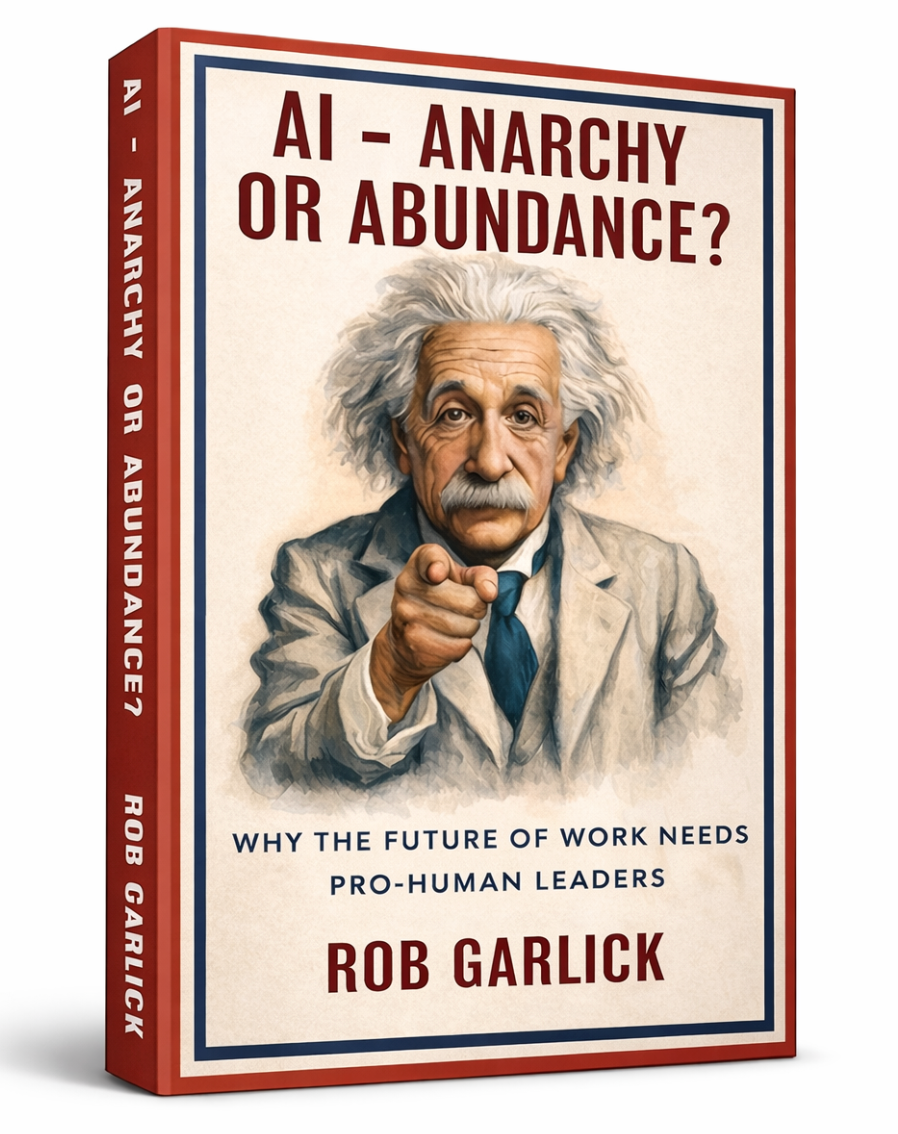
AI – Anarchy or Abundance? is a timely call to action for anyone concerned about the future of work. In the wake of the 2008 Financial Crisis, Queen Elizabeth II famously asked: ‘Why did nobody see it coming?’

As today’s AI revolution reshapes work at unprecedented speed, the question is no longer whether we see it coming—but what we choose to do about it.

The trends advantage pro-machine and pro-profit thinking, but our future depends less on technology itself than on choosing pro-human leadership.

Having surfaced over 100 solutions, a simple BEEST framework is offered to navigate the key issues to ensure that AI benefits many.

Rob Garlick is a visiting professor at the Future of Work Research Centre at the University of Surrey and previously served as Head of Innovation and Technology at Citi Global Insights.

  • A Wake-Up Call for Every Leader Who Thinks They Have Time

    Garlick shows, in plain language, how billions of non-human workers, AI agents, and robots will collide with our current systems—and what Pro-Human leaders must do now to grow profits and people. AI - Anarchy or Abundance? is the rare book that makes you both uneasy and deeply hopeful, then hands you a path forward.

    Dr. Marshall Goldsmith is the Thinkers50 #1 Executive Coach and New York Times bestselling author of The Earned Life, Triggers, and What Got You Here Won’t Get You There

  • Required Reading for Any CEO Who Says, “People Are Our Greatest Asset”


    If you’ve ever stood in front of your organisation and claimed that “people are our greatest asset,” this book quietly asks, Do your AI decisions prove it? Garlick draws a stark line between leaders who use AI to squeeze labour costs and those who use it to create better work and better organisations. This is a business book that will sit in your conscience as much as your strategy offsite.

    Professor Ying Zhou, Director of the Future of Work Research Centre at the University of Surrey

  • From “Weak Competition” to Strong Leadership

    Garlick’s long history with technological change underpins his forecasts for what’s ahead. The point that humanity has entered a period of “weak competition” with AI is both chilling and clarifying. This book will unsettle some but also embolden leaders who want to win without breaking the social contract. It’s less about fear or hype and more about responsibility. It is timely, balanced, and very insightful.

    Naveed Sultan, Professor of Practice at Imperial College Business School and Former Global Chairman of Citigroup's Institutional Business Group

  • A Playbook for Pro-Human Capitalism

    Leaders across private, public and social sectors are navigating extraordinary times. Decisions made over the next few years will have profound implications for how we live and work, and how our economies and societies evolve and transform. Garlick not only argues for a pro-human stance in an AI age, he explores realistic strategies to bend the power of capitalism towards more positive outcomes for people - all those who are alive today and those yet to be born. Anyone with decision-making responsibilities should read this book now to be more equipped to shape a better future for us all.

    Sarah Gillard, CEO of Blueprint for Better Business

  • The BESST Framework Is a Gift to Future-Facing Boards


    The developments in artificial intelligence are game-changing for many businesses. For directors pulled between shorter-term shareholder returns and long-term system stability, this book gives boards a language and framework to hold that tension honestly. Garlick’s BESST framework turns a chaotic debate about the impact of AI on business and work into a simple, sticky tool that boards and C-suites need and can use.

    Hitesh Thakrar, Member of the Board of Trustees of Alan Turing Institute, Cancer Research UK, and STFC Council, and Partner at Syncona Limited

  • A Compass for Governments Standing at the AI Crossroads


    Instead of peddling doom or fairy tales, Garlick offers what governments actually need: a grounded, data-rich guide to what happens to wages, jobs, tax bases, and social stability when AI and robots scale faster than our safety nets. His examination of the options provides a handbook on how societies can “vote” on the AI paths ahead.

    Professor Ian Goldin, Professor of Globalisation and Development at the University of Oxford and Founding Director of the Oxford Martin Research Programmes